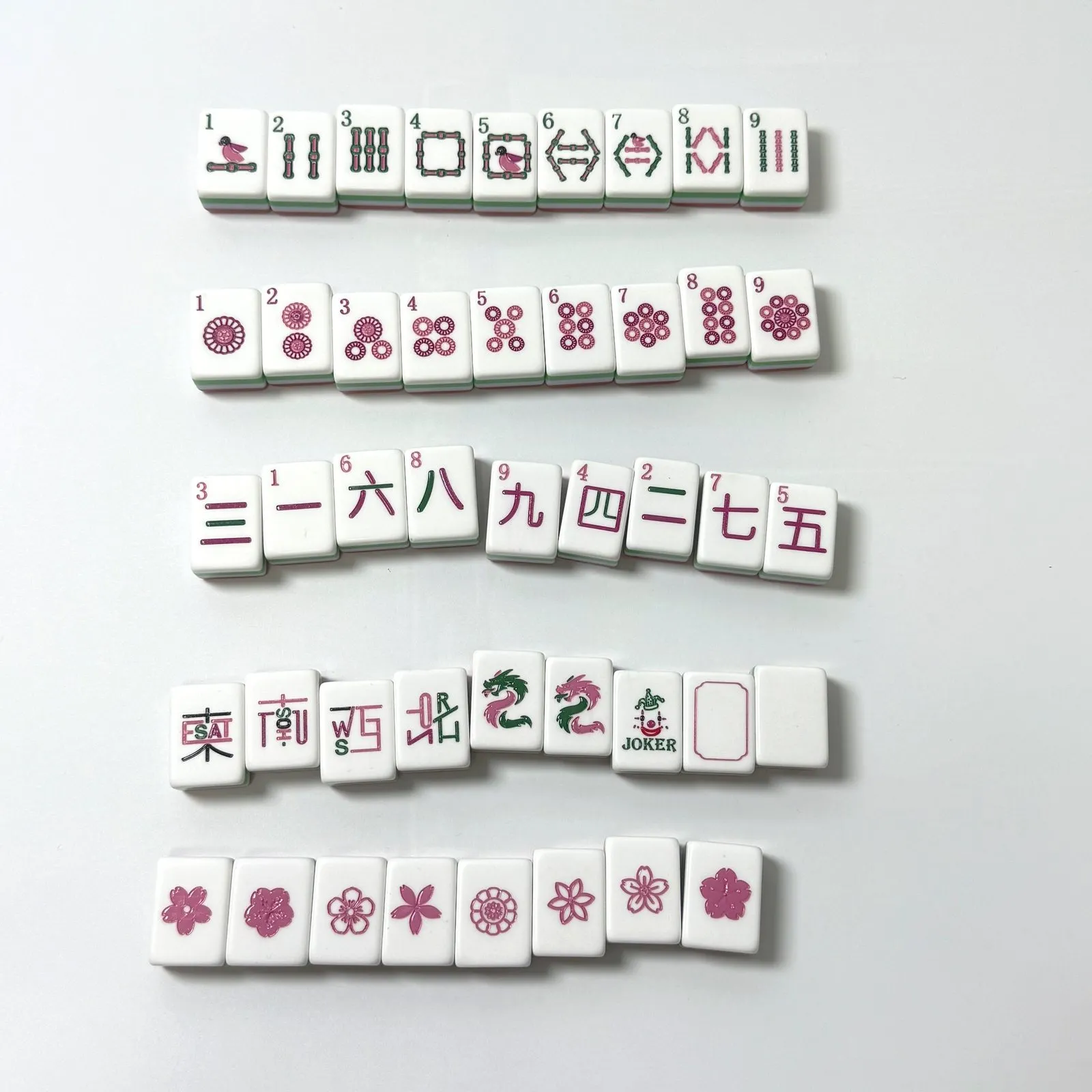
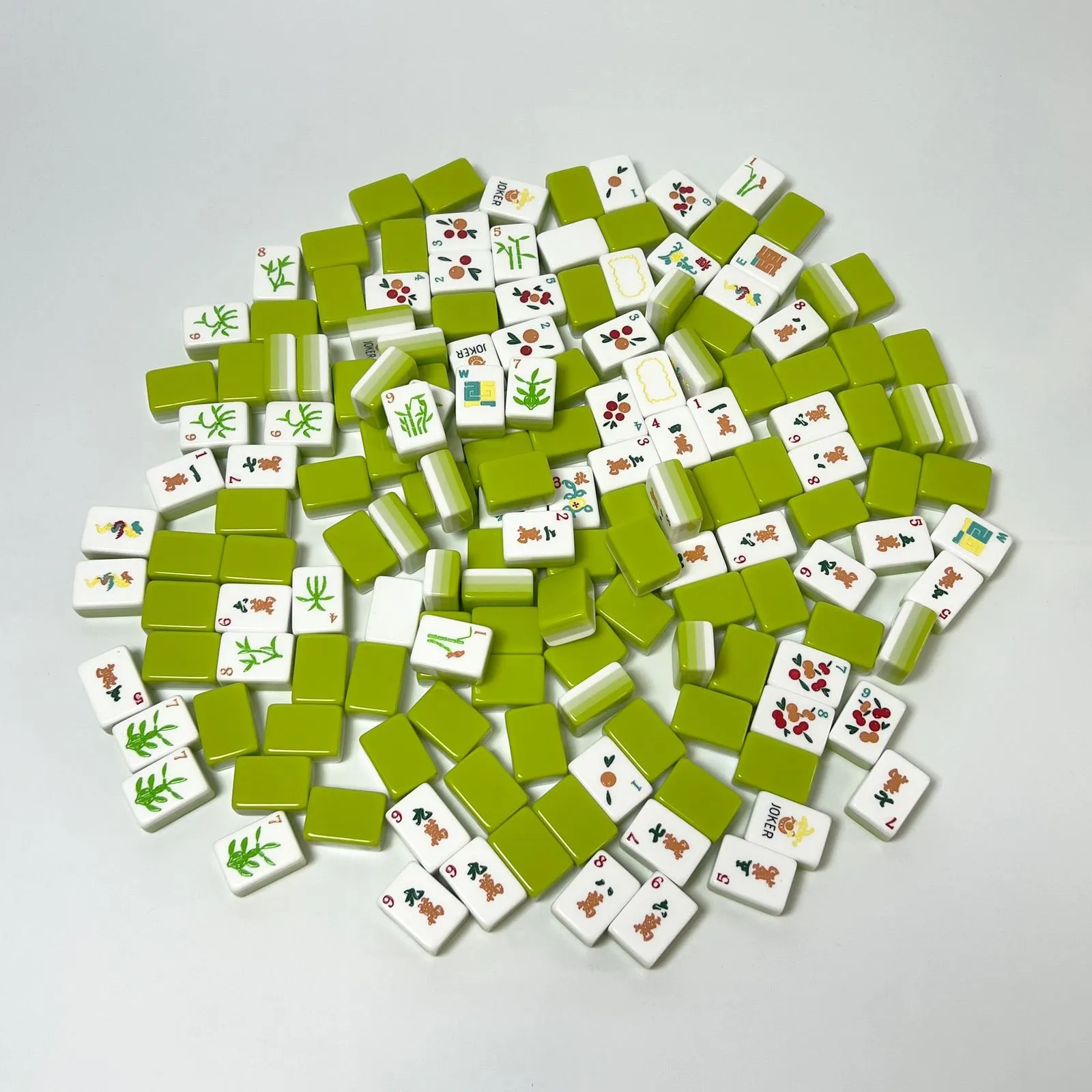
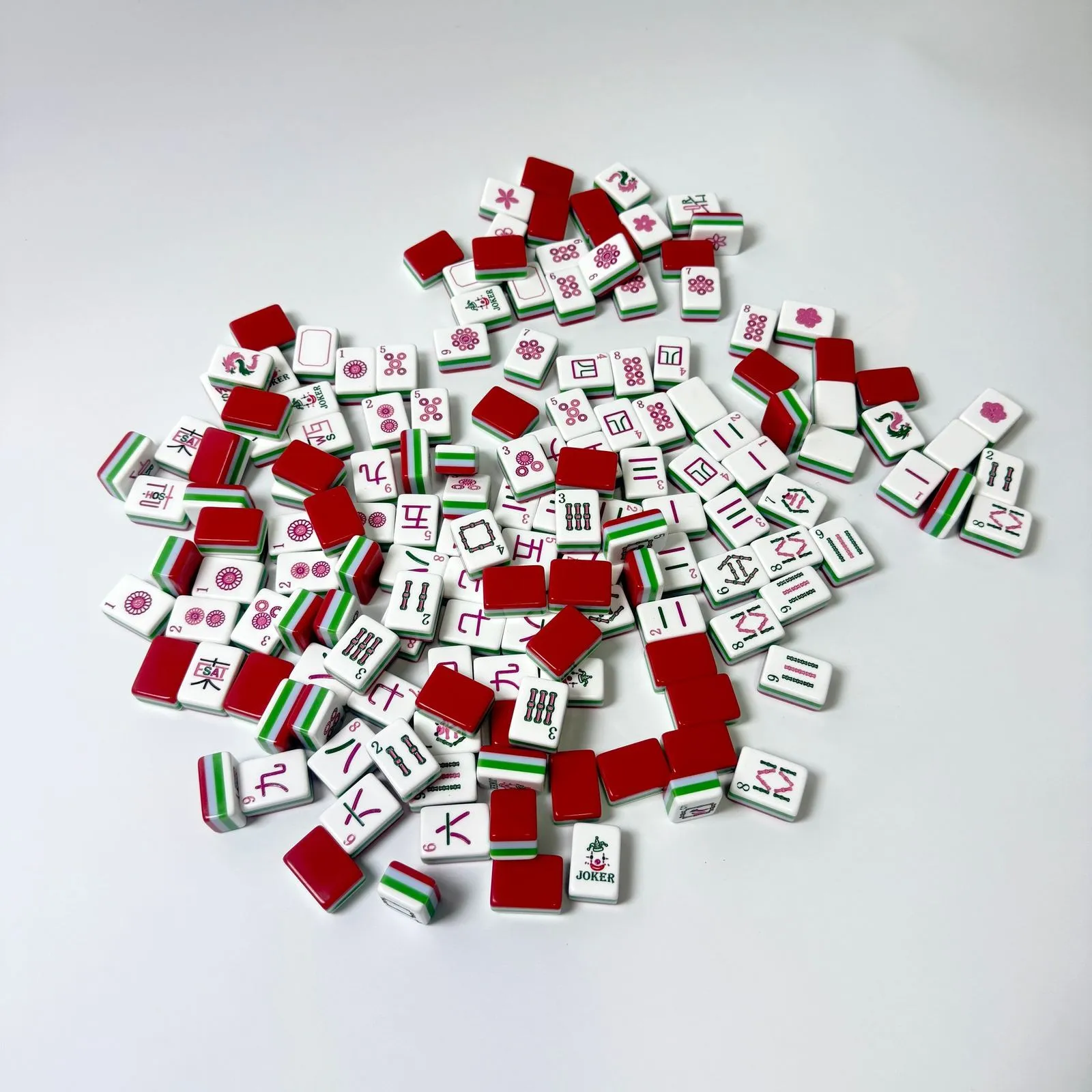
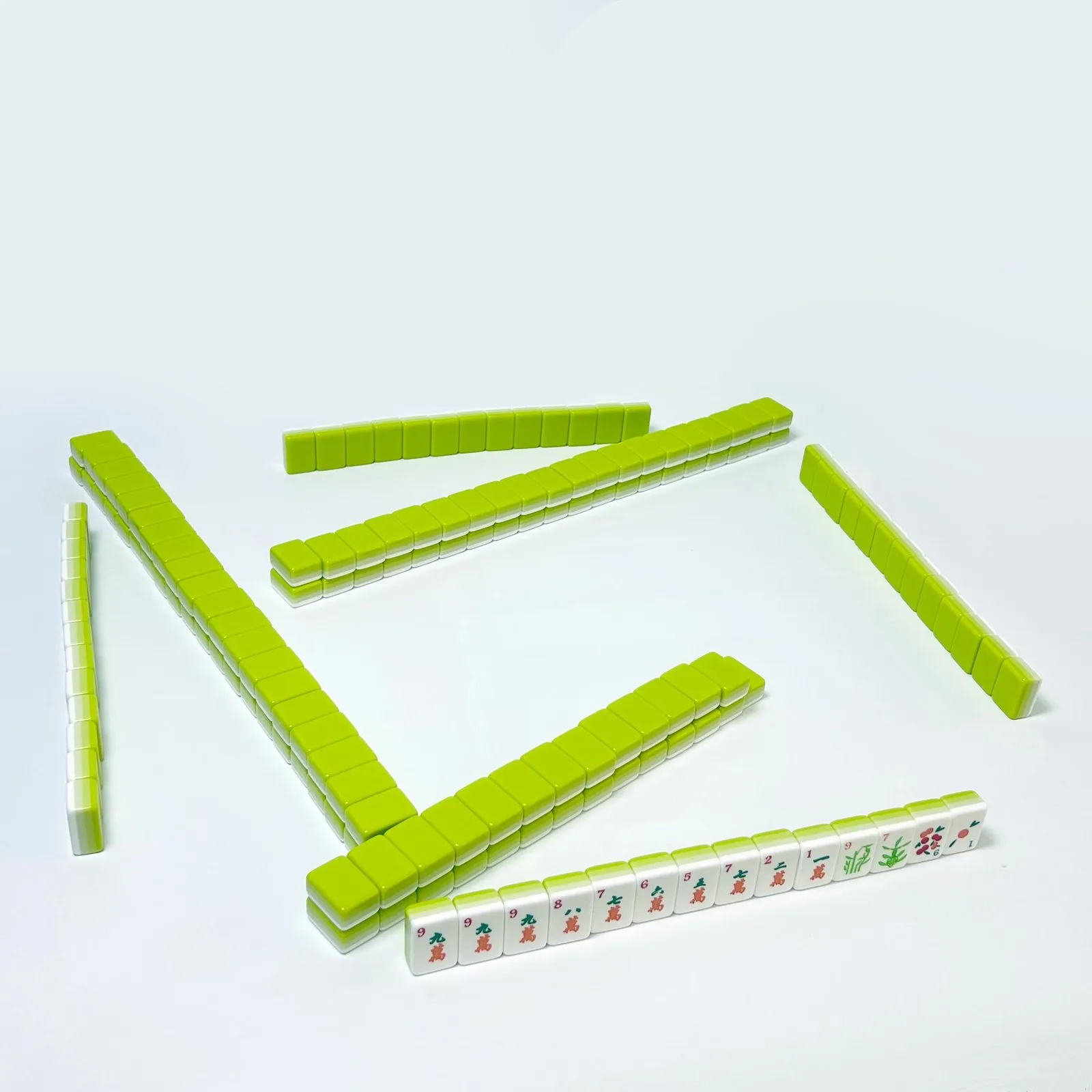
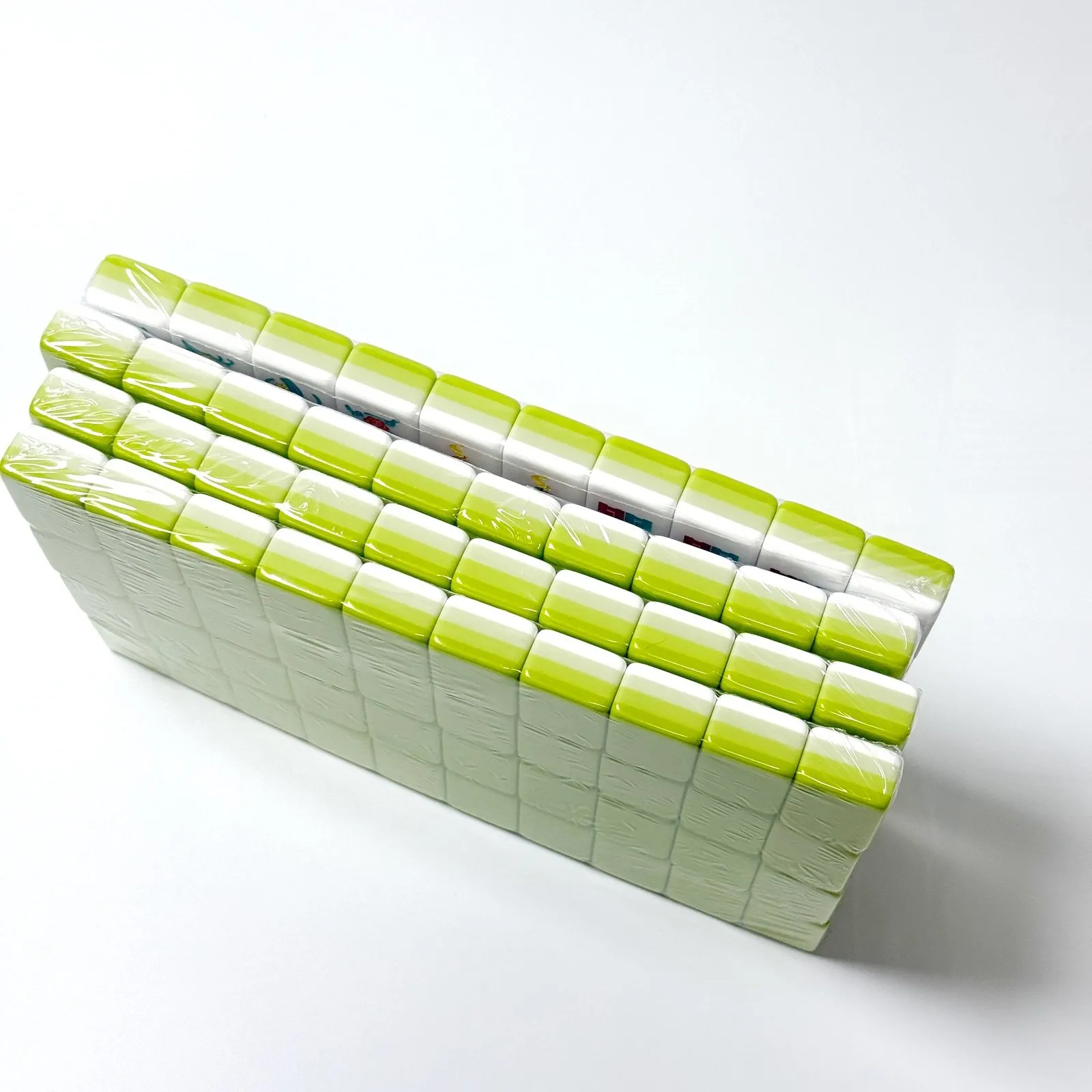
The tile is the whole product here, so the decisions that matter are the face size, how many layers you build into the body, and how deep the engraving runs.
Face size
| Version | Face | Typical use |
|---|---|---|
| Standard | 36.5 × 25.4 mm | American sets for club and home play |
| Travel | 32 × 23 mm | Compact sets where the case has to stay small |
Both run the same finishing; only the footprint changes. If your buyer already owns a set, measure three tiles from it and send the averages — that is faster than arguing about what “standard” means.
Layer construction
Tiles are built in one, two, three or four layers, and every layer can be a different Pantone colour. Layer count is not cosmetic:
- A single layer gives a solid body at the lowest unit cost.
- Adding layers lets the face and the body carry different colours, and lets a printed or inlaid face sit on a body of another tone without bleed-through.
- The four-layer build is what you want when the side of the tile has to read as a distinct band — the detail buyers notice when they pick a tile up.
Specialty bodies — marble, pearl, tortoiseshell and resin jade — are poured in small batches, so a reorder months later will not match exactly. Keep a master sample and accept a tolerance, or commit to a single large run.
Before any of that, the sheet is cut into blanks. Every tile starts here, already at the right depth for its layer count:
How the face is made
Two machines, one process — not two alternatives. The pattern is laser engraved 0.3–0.5 mm into the tile face, and the same lines are then filled with UV ink in the colours of your artwork.
That is why the face lasts: the colour sits inside the groove rather than on top of the acrylic. A tile can be shuffled for a decade and the design is still there, because there was never a printed layer to wear through.
What the engraving buys you:
- Crisp edges. The engraved line is a physical wall; ink cannot bleed past it, so fine strokes stay fine.
- Depth you can feel. 0.3 mm reads as a fine line, 0.5 mm as a heavier, more tactile mark — useful when the design should be legible by touch as well as sight.
- A flush face. Nothing stands proud of the surface, so tiles slide cleanly and the face does not catch light the way a thick printed layer does.
Multi-colour artwork is filled in one pass: the UV head prints into the engraving, so a four-colour character and a single-colour logo go through the same two steps — only the artwork differs.
The second step, on the same line: the UV head travels over a full bed of blanks and cures the ink into those grooves.
Your design stays yours
We make mahjong for brands, and a brand’s tile design is the brand. So:
- We do not show your artwork to another buyer, and we do not reuse it — not as a sample, not as a catalogue photo, not as a “reference design”.
- Photographs of your run are not published without your written approval.
- Files, tooling and print plates for your design are not passed to anyone else.
- If a competitor asks us to make something that is clearly your design, we decline.
This is not a clause we added for the website. It is how the factory has stayed in business: customers return because their designs are safe here.
How pricing works
Four things move the price of a set: layer count (1 to 4, each layer its own Pantone), print coverage on the face, body finish (solid, pearl, marble, tortoiseshell or resin jade), and what ships with it — tiles alone, or packed with racks and a case.
Quantity moves it more than anything else: 200 sets and 1,000 sets are different prices per set, and the gap is not small. Tell us the target quantity with the artwork and we quote that tier exactly, not a range.
Getting a quote
Send the face size, the layer count, the colourway reference for each layer, and the artwork for the face — we engrave it and colour-fill it. Tell us whether the set ships as tiles only or packed with racks and a case — those quote as separate lines so you can see what each adds.
Small runs are welcome: the minimum is 200 sets.
Sample pricing and detailed specifications are quoted directly — email or WhatsApp us and we will send the full spec sheet for your version.
Timing, honestly
A 160-tile set is not a fast part. Each tile is cut, laminated, engraved and colour-filled and inspected, and a set runs to 160 pieces before anything is packed.
| Stage | Time |
|---|---|
| Sample (full set, engraved and colour-filled) | about 1 month |
| Bulk, 100–500 sets | 3–4 months |
If that window does not fit your launch date, tell us at quoting — the honest answer is better than a date we cannot hold.
Typical applications
- Mahjong clubs and tournament sets
- Gift and hobby retail
- Travel and compact sets
- Corporate and Lunar New Year gifting
More in Mahjong
mahjong
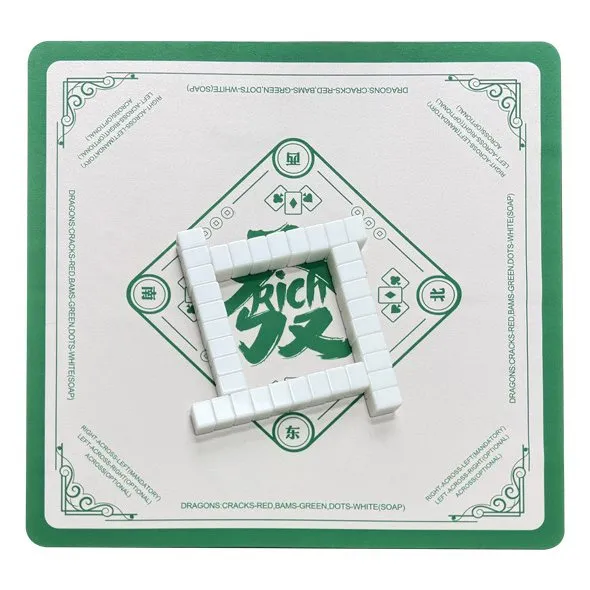
Custom Printing Mahjong Mat — 800 / 845 mm, Made to Your Artwork
Custom printing service for mahjong mats in 800 × 800 mm or 845 × 845 mm, 2 mm or 3 mm. Send the design as vector or PDF; bulk runs from 100 pcs, 50 per design.
mahjong
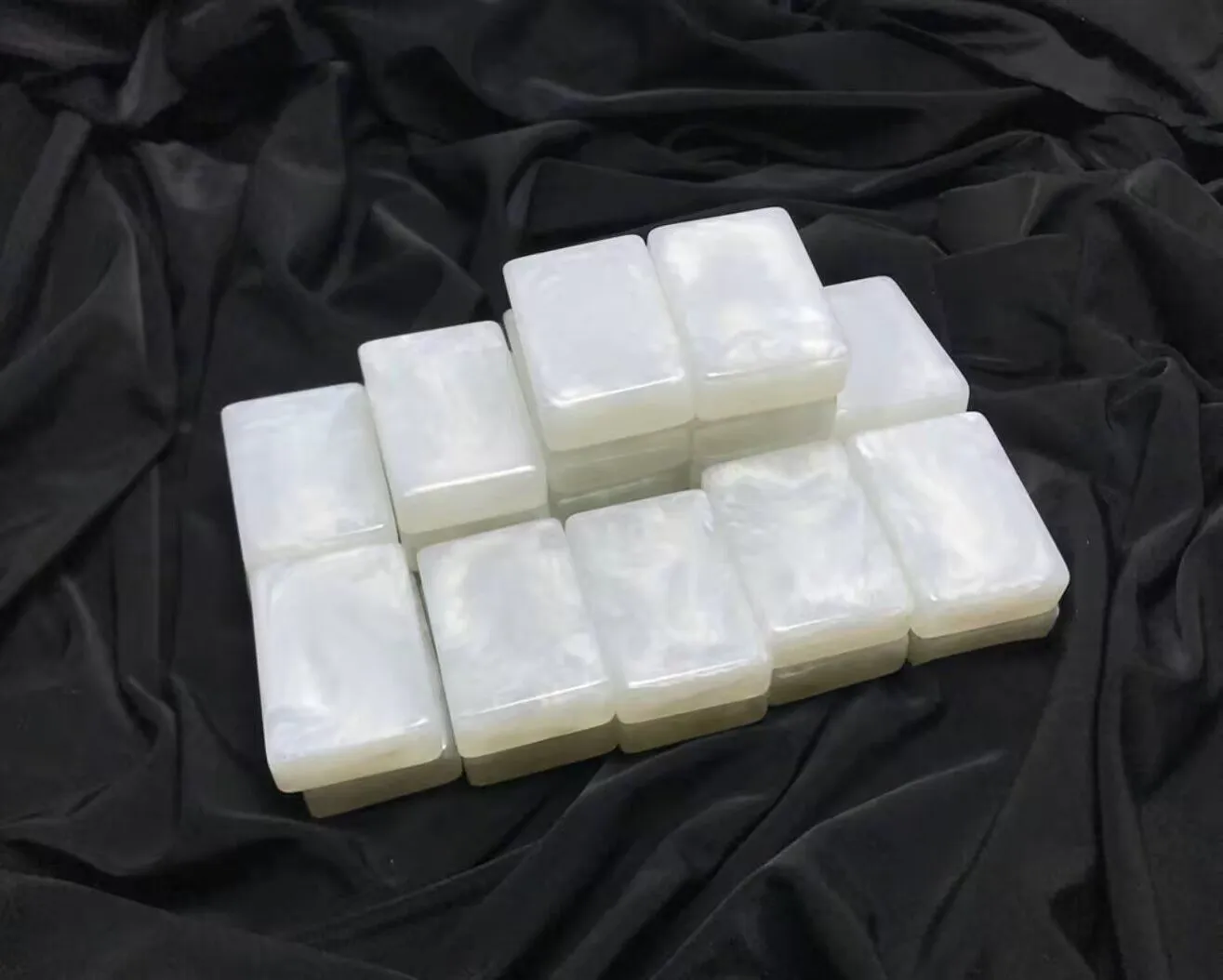
Premium Resin Jade Mahjong Tiles — 36.5 × 25.4 × 11 mm, Custom Pantone
Single-layer resin mahjong tiles in a jade-pearl finish, 36.5 × 25.4 × 11 mm, colour matched to your Pantone. 100 sets per colour, about 2 months.
mahjong
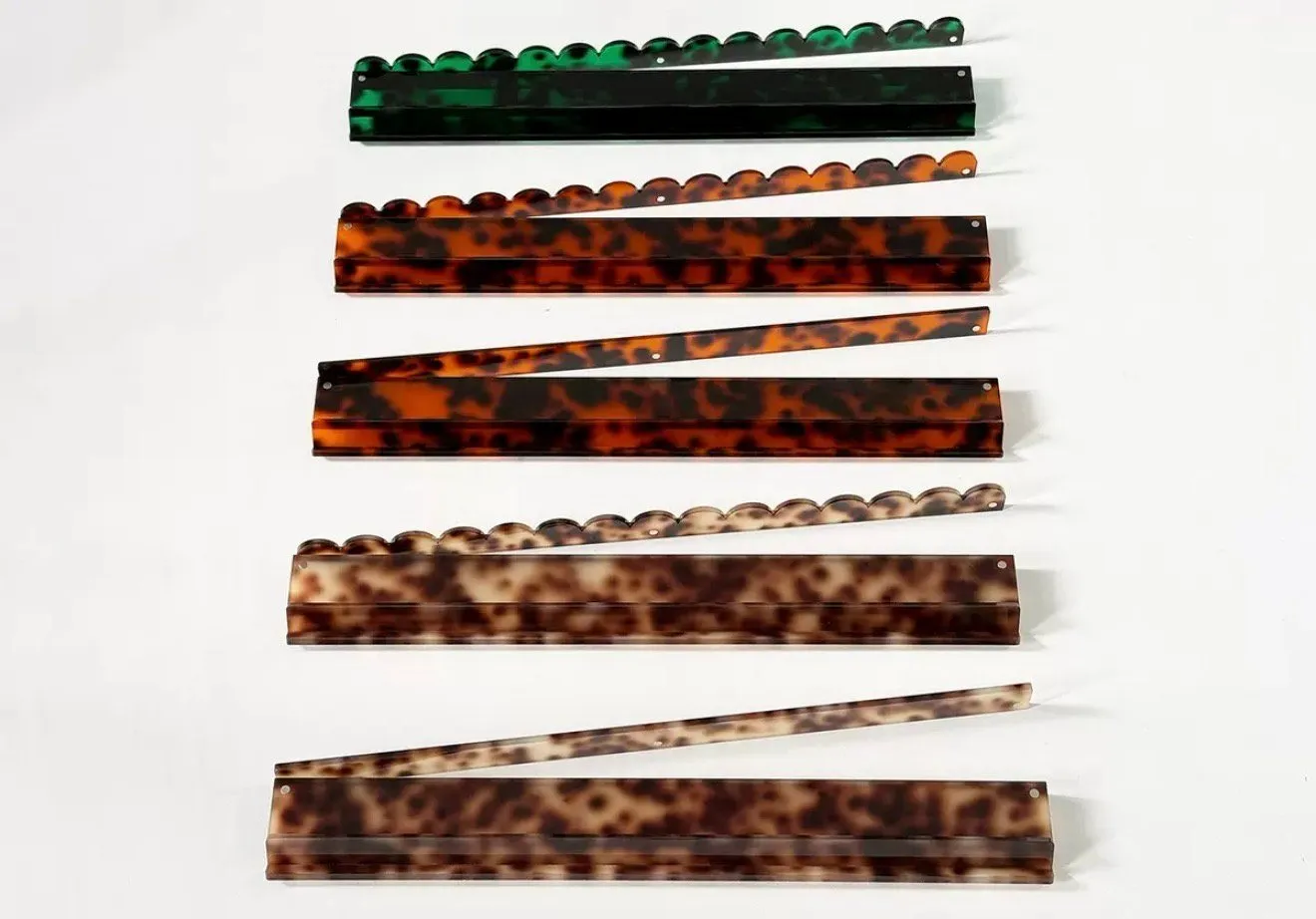
Magnetic Acrylic Mahjong Pusher & Rack Set — 19, 20, 21 inch, 5 or 6 mm
Magnetic acrylic mahjong pushers in 19, 20 and 21 inch, 5 or 6 mm thick, in clear, tortoise, marble or pearl — with 2–3 × 8 × 2 mm magnets and four to a set.
American Mahjong Tile Set — 36.5 × 25.4 mm, Engraved & UV Printed
Price on request · MOQ 200 sets